
Meaningful co-production in Durham
| Part of a toolkit for the ethical and effective use of children's information - practice examples.
How Durham County Council is using meaningful co-production to embed voice in system design
Sarah Rothera, Research in Practice Associate and and Shelley Gill, Principal Social Worker (Durham County Council) looked at how Durham County Council (DCC) provide a strong example of a transformative, values-led approach to co-production.
DCC show how public sector systems can go beyond just following rules, and instead how they can create services that are relational, ethical, and effective. DCCs aim is to put children at the heart of everything they do. They use a range of strategies to meaningfully incorporate voice into system design, and don't just offer token engagement on the lower levels of the Ladder of co-production. They reach higher levels by delegating power, budget control, and strategic governance to communities and frontline workers.
Read and listen to examples that detail how systems can be created based on the real experiences of children and families. Illustrating how local authorities can enhance children's information systems, and they also highlight how incorporating diverse voices can shape systems and improve outcomes.
At the heart of DCCs philosophy is the principle of "listening to hear" rather than "listening to reply" Achieving this gold standard requires professional bravery. It means confronting systemic barriers, institutional defensiveness, and challenging the status quo. It means looking beyond compliance metrics that may show high performance but mask underlying human needs. It means sitting with the discomfort of co-production to hear what is not working and why.
DCC realised there was a need to build trust so people could speak freely. This mistrust was a legacy of tokenistic consultation and projects that did not deliver meaningful results in the past. To address this, they set out to create psychologically safe spaces to think about how to improve the system.
Some key principles that stand out from DCCs approach to co-production include:
-
Start by building informal relationships and trust through daily interactions. This should happen before introducing people to formal governance structures.
-
Invest actively in reaching out to underrepresented, quieter, or marginalised groups. Don't just rely on articulate and visible representatives.
-
Use peer-led partners to create psychologically safe spaces. Here, service users and frontline staff can share honest feedback without fear of consequences.
-
Practice active, reflective listening. Learn to sit with uncomfortable feedback to dismantle institutional defensiveness. Listening closely to stakeholders' experiences can help identify underlying issues.
-
Build co-production into the fabric of the organisation (not just one of consultations). Create forums with a clear purpose. Involve members in shaping how things operate.
-
Go beyond simple consultation. Have the courage to share power and delegate responsibility. Give real financial authority, budget management, and decision-making power to people who access services. Let them decide their inquiry topics, set governance rules, and design service pathways together from the start.
-
Combine rich qualitative lived-experience narratives with quantitative metrics. This creates strong evidence for decision-makers but keeps people at the centre. Integrate shared insights into case management software, recording tools, and practice pathways. This way, user perspectives create a strong link across all systems.
-
Create two-way feedback loops. Leaders should feedback to stakeholders and show how they have acted on recommendations. This creates a shared value exchange and builds trust. It shows people that what they contribute matters.
-
Invest time, money, and effort into deep co-production. This upfront work helps create strong, tested models. By doing this, you can avoid expensive service failures and redesigns later.
Learn more about how DCC puts these principles into action with this short video: Children at the heart of everything we do.
Durham County Councils (DCC) Families First Transformation built on a journey that began years earlier. Leaders already had a strong commitment to family group decision-making. While DCC was not a pathfinder themselves, they applied lessons from the initiative. They adapted existing infrastructure and placed collaboration at the centre of system redesign. They embarked on an intensive period of co-production to redesign their system.
Independent partnership with The Care Leaders
DCC commissioned The Care Leaders, a care-experienced community interest company, to lead engagement. This partnership brought in specialist skills in technology, media, and creative design. It recognised that internal systems were busy and limited by corporate processes. It shared power by placing care-experienced people in leadership. This created a safe space for staff and families to give honest feedback.
Whole-system scope and targeted voice amplification
Engagement included all parts of the system:
-
children, parents, carers, kinship, and foster carers,
-
frontline workers and leaders from early help and statutory teams, and
-
multi-agency partners in health, education, and the voluntary sector.
DCC focused on engaging traditionally "quieter" voices. This includes neurodivergent staff, global majority colleagues, and marginalised families. Children and young people spoke directly to senior management, the full council, and the Durham Family panel. This way, political and strategic leaders could hear their recommendations personally.
Focused 3-month intensive engagement phase
DCC and The Care Leaders ran an intensive "test and learn" co-production phase. They used a wide range of approaches.
-
Led focus groups and creative workshops for 48 teams. This included both in-scope teams and out-of-scope support services.
-
A Microsoft Forms survey was available to all staff for three months.
-
Two-way communication was key. They shared updates through newsletters, Microsoft Teams, and events.
-
They talked one-on-one with children, parents, and carers to map out personal journeys (51).
-
Gave weekly feedback to share insights with leadership. This allowed urgent family issues, not in standard reports, to be addressed quickly.
-
Delivered targeted engagement to less heard communities.
Multi-media and digital technology integration
Multi-media and digital technologies were seen as an important part of the process. Some strategies that were used include:
-
Short films and podcasts that capture feedback from young people, carers, staff, and senior leaders. These were used to share information, provide feedback and to spark open discussions.
-
Project management platforms provided a more dynamic and organised approach to project management. These applications saved time and helped organise and track workflows.
-
Digital channels and direct messaging made it easier to share information, coordinate, and give feedback. Transformation leads kept in touch with stakeholders and gave real-time updates.
Redesigning the system
Together they redesigned a locality front door and family help model to align with Families First principles. They learned that the system felt fragmented. Families were shuffled between teams, and their stories often got lost in the bureaucracy. It often felt difficult to get the right help from the right person. Under the redesign, a consistent key worker offers continuity and expertise.
The overall design mattered, but it was clear that processes and bureaucracy influence practice. The transformation team invested significant time and effort into reshaping the information system. For example, assessment and care planning forms in LiquidLogic were collaboratively redesigned. They carried this out across safeguarding and early help. The aim was to ensure family voice acts as a genuine golden thread throughout case records.
The intensive co-productive approach helped to surface a range of systemic issues. Leaders heard first-hand experiences of service and were able to respond to concerns.
Durham County Council (DCC) 'Experts through experience' group is a youth-led project. It involves care-experienced young people in its design and delivery. In this group, young people act as independent peer researchers, analysts, and change-makers. They move past traditional consultation by setting their own inquiry agendas.
Youth-led inquiry
The programme trains and supports young people to research what living in the social care system really feels like. The young people retain full control over topic selection. They choose subjects to research and design and deliver the research project. Peer researchers use various creative methods to achieve their goals, such as:
-
Conducting craft-based sessions, guided walks, interviews, and open-box anonymous surveys to hear about lived experiences.
-
Translating personal stories into statistics. This connects real experiences with data. Managers can use this in their decision-making.
The young people make a meaningful contribution while learning valuable research skills.
Ethics, professional skills and emotional safety
DCC prepare and support young people to undertake peer research. They offer thorough training that emphasises psychological safety for both themselves and the young people they support. They also learn key research skills:
-
Peer researchers learn about data protection, confidentiality, and corporate processes. This helps them make sense of how things work.
-
Peer researchers learn to give constructive feedback in a professional way. This helps ensure that corporate leaders value their insights.
-
There is an emphasis on psychological safety. Feedback may be triggering for peer researchers and their peers. Peer researchers learn to create safe spaces for themselves and others. Researchers and interviewees get debrief sessions when studying tough emotional topics.
Examples of completed projects
Peer research has led to some significant changes in how things are done:
-
Peer researchers looked into how the care system supports brothers and sisters. This prompted some important changes. They moved from the term "contact" to "family time". They also redesigned physical spaces for family time and updated workforce training.
-
Peer researchers studied the barriers and discrimination young people with care experience encounter. This research led DCC to see care experience as a protected characteristic. This helps to secure job interviews for care leavers across council departments.
-
Peer researchers looked at the stigma faced by care-experienced young people in the social care system. This included less-heard groups like neurodivergent young people, global majority groups, and gypsy/roma/traveller communities. This research provided important insights to senior leadership to help reshape practice culture.
Double benefit of shared power
The experts through experience approach is an example of co-production as shared power. For the council, it yields rigorous, grounded evidence that challenges institutional assumptions. They learn data analysis, manage complex systems, and hold senior leaders accountable.
It offers young people a chance to build skills, but it also has a therapeutic quality. Young people often feel disempowered by the system and their experiences. Delegating power helps them to develop a sense of ownership and influence. This is empowering.
Senior managers report back on how they have put the peer researchers' recommendations into practice. This accountability has led to real improvements in the system. It is also evidence to young people that their voice matters.
Learn more with this short video: Durham County Council - Experts through experience.
Durham County Council (DCC) Next Venture Fund is an initiative led by young people for young people. It gives young people with care experience real financial authority and decision-making power. The Fund sees young people as system designers, governors, and resource allocators right from the start. Instead of asking them about pre-designed plans, it involves them in creating their own solutions.
A shift in mindset
The scheme grew from a fundamental shift in mindset: What if young people decided how some of the budget was spent? Supported by participation staff, young people co-created the scheme from the ground up. They:
-
Agreed the purpose, rules, eligibility criteria, and decision-making processes.
-
Created roles, like Chair and Treasurer. These roles are filled by the young people.
-
Built their own governance arrangements rather than accepting top-down organisational structures.
Youth led decision-making
The group have a budget that they can allocate to projects. The panel invites project bids from peers, local groups, and services. Bids can include small items such as games, hub equipment, or upgrades to shared areas. They also cover bigger projects that focus on improving relationships, belonging, and opportunities.
Once submissions are received, the panel assesses each proposal based on specific criteria.
-
They look at the relevance, feasibility, and potential impact of the projects.
-
Young people consider impact, fairness, and value for money. They debate the merits of each application before making final funding decisions.
-
After thorough discussions, the panel members decide which projects to fund.
-
Adults play a supportive, advisory role. They don't overrule panel decisions.
This teamwork ensures the chosen initiatives meet the community's needs and interests. They also gain important skills in collaboration, prioritisation, and budgeting.
Benefits of shared power
The Next Venture Fund provides a range of key benefits to young people and the organisation:
-
Provides valuable insights about what matters to care-experienced youth.
-
It directs resources to changes that enhance daily life.
-
Demonstrates that young people can be trusted to make valuable contributions if they are given the opportunity.
-
Supports young people to develop important skills. They practice chairing meetings, managing budgets, applying criteria consistently, navigating disagreements, and explaining decisions to senior leaders.
Durham County Council (DCC) Future Hope programme is a co-produced, specialist service developed alongside women who have had children removed through care proceedings. DCC built on the traditional Pause model. They brought the initiative in-house to improve co-production, outcomes, and cost efficiency. The programme helps support women after removal. The programme focuses on stability, planning for the future, and reducing the risk of repeat removals.
Co-producing the programme
Women with lived experience co-produced Future Hope from the ground up. They shaped its name, branding, service paths, and daily operations. Direct feedback from participants fundamentally altered the approach to assessment and support:
-
There is a focus on earlier support. Support can now begin right after one child is removed, not just after several.
-
It is recognised that care leavers need extra support.
-
A trauma-informed and systems approach was taken. New pre-birth assessment and support pathways were designed. Now, there are specific pathways for teenagers, parents with learning difficulties and disabilities, and women with care experience.
Relational practice model and culture shift
The practice model focuses on non-judgemental, long-term, one-on-one support. Participants often say this is the most valuable part of the service. Moving beyond service delivery, women co-deliver training and workshops for social care practitioners. Sharing personal stories challenges assumptions and changes the work culture. It promotes curiosity, empathy, and kindness. Graduates stay connected through light-touch follow-ups. This keeps an ongoing feedback loop that helps shape service design.
Future direction and systemic influence
Future Hope is setting up a women-led advisory board. This board will guide advocacy efforts and projects. These projects involve Future Hope members in updating assessment tools and redesigning the "goodbye for now" contact processes with compassion.
Future Hope is a strong example of how to transform traumatic experiences through delegated power. It influences pre-birth pathways, practitioner training, and the design of wider systems over the long term.
Featured below is a series of podcast clips in which we hear from women with experience of working with Future Hope.
Feedback from women with experience of working with Future Hope
The Future Hope programme is a co-produced, specialist service developed alongside women who have had children removed through care proceedings. Durham County Council built this programme, based on the traditional Pause model. For more information, see Future Hope Programme above.
If another local authority wanted to co‑produce a service like Future Hope with women? What advice would you give them about how to do it, so it feels genuine and not tokenistic?
Advice for co-production:
Do your research beforehand. Every case is different and a lot of the time there’s often a lot of mental health issues… Let’s work together and show empathy. You haven’t experienced having your child removed but I have, so if you want me to be honest, I need to know I can trust you first.
We want to help and give our view and shape services but remember this is a topic that is so hard to remember and probably the most painful part of our lives, some of us are still working through the pain. It does get easier, but the pain is still there. So please be patient and always be kind.
(Future Hope graduate)
Looking back on your journey, what helped you feel safe, respected and in control when working with Future Hope? What would you tell other councils they must get right from the start?
…My worker dressed casual, no social worker vibes. The care and compassion is unmatched, I don’t think I’ve had a service as good as yours, it’s a level of respect. We got treated like human beings and not like criminals.
(a woman with experience of working with Future Hope)
What helped you feel safe, respect and in control? and What helps you feel trusted and respected?:
When you think about co‑producing Future Hope – helping to shape the name, the programme, the training and the hope boxes – what have you valued most about being involved, and why has that mattered to you personally?
Five years ago, I would never have stood up in front of professionals and social workers and now I’m the first in line.
(A Future Hope Graduate reflecting on co-facilitating training for professionals)
What have you valued? and What changes have you seen?:
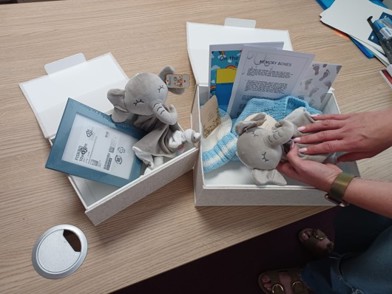
Next Stop Boxes
Modelled on the Nuffield Health Hope Boxes, the Next Step Boxes were put together with feedback from mothers who were separated from their children at birth.
In this short clip, we hear directly about the experience from a mother involved in the process.
Further to the audio feedback received, as clips above, the examples for Meaningful co-production in Durham also include some photographic materials from various sessions.
As pictured, a 'Next Step Box' was taken to a foster carer training session, and participants were asked for their feedback.
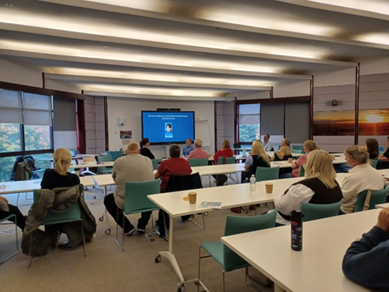
Co-production work
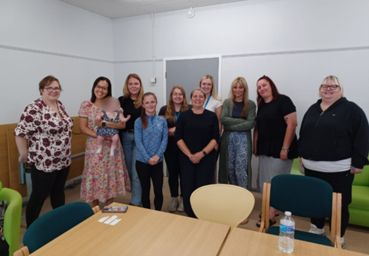
Two graduate women meeting with the Connecting Families Team to talk about what’s important to consider about birth parents when it comes to reunification.
New reunification parenting assessment
As part of strengthening practice within Durham Children’s Services, a combined parenting and return home assessment has been developed. Alongside this, a supporting letter for parents was created to clearly outline the purpose of the assessment, what it will involve, and what areas will be explored.
Future Hope was consulted as part of this development process, and their feedback was invaluable in shaping and refining the assessment and letter. This input helped ensure the approach is more responsive to the needs and experiences of families. It also gave valuable food for thought to feed into practice development.
Our aim is to make the assessment as accessible and transparent as possible for parents. While we recognise that assessments can understandably create anxiety, we want parents to feel informed, supported, and able to actively participate throughout the process.
We also recognise that when parents feel listened to and respected, this can support them to feel heard and empowered, which also supports better engagement and quality of assessment. This, in turn, contributes to more positive outcomes for children, young people, and their families.
(Reunification Team)
Learn more about Next Venture in this short video: The Next Venture Fund (Durham County Council).
Information use projects
Explore further multimedia examples that show and tell how using information ethically and effectively shapes systems and improves outcomes.
A toolkit for the ethical and effective use of children's information
Digital resources explore definitions, tools and examples for practitioners and data leads to strengthen children's information use.