What is a Family and Group Conference like?
Part of Family and Group Conferencing for Adults. Select the quick links below to explore the key sections of this page.
What is a Family and Group Conference? The process of a FGC What does a FGC feel like? Further information and resources
Introduction
Aimed at adults with care and support needs, their families and friends, and anyone else in their support network. This section explains what a Family and Group Conference (FGC) is, how it feels and why it makes a difference.
What is a FGC?
Family and Group Conferences (FGCs) for Adults are meetings where a supportive network of family and friends come together to help address the needs of an individual. The meeting is voluntary and supported by an independent coordinator.
This video explains how a FGC happens and what your role may be.
[What is a Family and Group Conference (FGC)?]
Voiceover: A Family and Group Conference, or FGC, is a person-centred approach that can be used in social care and health settings. It brings together a person who has care and support needs with the people in their support network - family, friends, and anyone else who loves and supports them. Everyone in the FGC is there because the person wants them to be. In this short film, you'll hear from people who have experienced Family and Group Conferences, whether that's as a participant or as a professional, and they will talk through how they work and the impact that they can have.
Michaela: It wasn't like professionals-led where they were fully taking control. I was at con- I was at the centre of it. I got to decide who was going to come to, come to the conference. I got to decide what kind of support that I wanted. I was listened to throughout - there was nobody sitting behind desks who, who were able to, who drew their own conclusion about me. I was able to present myself and they would just see that this is who I am. It was good because it wasn't really formal.
Voiceover: On screen now, you can see the whole process of a Family and Group Conference. While everyone's experience is very unique, there is a defined structure for Family and Group Conferences. Each Family and Group Conference will also have a coordinator. They are always trained in preparing for, facilitating, and following up the Family Group Conference.
[Inviting who you want to come]
Voiceover: To make sure that everyone gets the best out of the conference, the coordinator's work begins early on. They will always meet with the central person in the FGC, so both person and coordinator can plan the meeting together. It is the central person who chooses who to invite to the conference. Family members, friends, and professionals. The central person also chooses where the conference will take place. This will be somewhere that they, and those they wish to invite, feel comfortable, so preferably not in an office or a clinical setting. The preparation also includes making sure that any accessibility needs are met. During this preparation time, the coordinator and the person will also get to know one another, making for a really personalised experience. The coordinator will also talk to other people invited to the FGC to explain the process, calm nerves, and answer any questions.
Anna: Leading up to the conference, I met up with my coordinator roughly, um, every week. We would work on, um, a document together that kind of outlined what recovery looked like to me, what my struggles were, what I wanted from my future. So that really helped me to decide kind of... what I wanted to bring to the conference.
Debi: So the FGC coordinator initially contacted me by telephone. And we had numerous telephone calls actually prior to the meeting. He was excellent in offering support before, um, us coming down on the train. Even when we were down on the train, meeting us at, um, King's Cross. Just lovely person, excellent support.
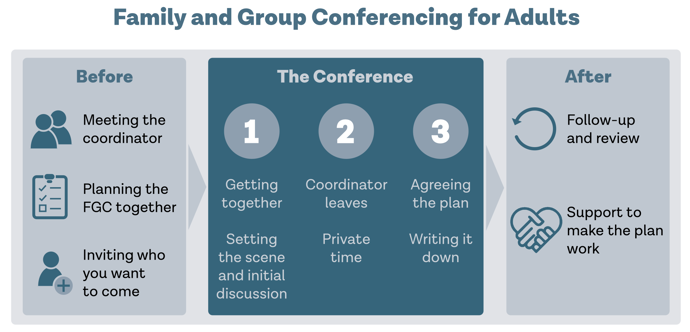
[1. Getting together: Setting the scene and initial discussion]
Voiceover: On the day of the FGC, it will often start with sharing food or another activity to help everyone feel relaxed. The venue will be the person's choice, so that will really help with feeling comfortable, and setting the scene for the discussion to come.
Sam: And there was a few people, but we weren't too far apart, so we were able to hear each other, and it just felt very relaxed, um, and yeah, very comfortable.
Suzanne: I think in my FGCs of, although they're a l- they're much more informal, there is a little bit of anxiety f- um, to start off with. Um, so I think it's really important, you know, in that kind of opening, that it, you know, people understand why we're here, and the reasons why we're here, and who we're to discu- you know, what we're discussing. So I think if you, I think if that's made pretty clear at the, the beginning, and about how, and I think it, which is all, which is very key is explaining the day and how it will, um, how the day will be.
Rebecca: The, the lady sat us down, and she kind of took the lead for a while, and asked loads of questions, and there was a little bit of tension, I guess. Um, but then she gave us the opportunity to have some time just us to discuss things, and come up with a plan, and that was really helpful because then, especially my sister, felt she could speak freely, um, and we could help her voice her opinions as well.
[2. Coordinator leaves: Private time]
Voiceover: As Rebecca mentioned, once the scene has been set, the coordinator will leave and private time begins. Private time, sometimes called family time, is when the person and everyone they've invited gets to discuss the situation. It's a key part of what makes family and group conferences a unique experience.
Azara: Private time, myself and any other professional there will leave the room.... um, myself and the social worker particularly, there have been times when people have requested for their advocate to be with them, dependent on their situation, dependent on how they feel, um, with the, even with their family members or their support network. So, you know, they... It's, it's up to the family to choose who they want to stay with them, you know? But for me, I have to leave the room. I've said to people, 'Even if it's for 20 minutes, half an hour, otherwise it's not a Family Group Conference.'
Michaela: We had, um, time on our own as a family and as, as with my friends to talk between us before we came back, which was really good.
Anna: Just having that arrangement of, on this day, we're going to sit down and talk, that was really beneficial.
Suzanne: One of the, the, the good things I like, I really like about, um, Family Group Conference is that when they have the family time, and you as, as a practitioner, you step away. This is your time to work out how things could go or should go in, you know, ahead. I think as a, you know, in adult social care and as a social worker, um, you have to be aware of the impact and your... That kind of power dynamics is also important. But I think what's, um, Family Group Conference does quite neatly hands it over to the family. You have the power. You have the decision-making. You come up with a plan of, of working out and supporting the person rather than the social worker dictating everything. So I think that's really important.
[3. Agreeing the plan: Writing it down]
Voiceover: After private time ends, and it can take as long as needed, the coordinator will return. Now is the time when the plan is firmed up and put down on paper.
Azara: So they call us back in, and then usually we go in, and we go through the plan. And sometimes because it's a new process, people sometimes don't know what to write. They think they're doing the plan for the social worker. Or they're doing it for the... You know, so let's answer these questions so that it sounds professional. Let's answer this to... So that it looks like... I always say to people, 'Look, just write it any way you want. It's your plan.'
Rebecca: The plan was basically all her, with support, which is what she needed, I think.
Azara: No point in trying to use big words or whatever. Just write it any way that makes sense to you that you can relate to. Um, so when we come back in, that can be tricky sometimes because then I have to go and type it up. But if I don't understand what they're saying, it wouldn't make sense. So it helps me as well as a coordinator... the private time helps me as well to just solidify what people have said and what they, what they actually mean.
[After: Follow up and review]
Voiceover: The Family and Group Conference isn't just a moment in time. When the conference itself is over, the coordinator continues to work with the person and their network, seeing how the plan is working and keeping in touch. Usually, there is also a review conference too. This ensures everyone can get together again just like before and work out if anything needs to change. The experience of a Family Group Conference and the plan that comes from it can have a really big effect on everyone's lives.
Azara: I always say to families, 'Look, we don't have to come back if you don't want to,’ but it helps to come back because then you can then say... ‘Ok, even just to congratulate yourselves for doing a good, a good job.' Or if you're stuck with something, you know somebody, you, the professionals are there for us to say, 'Ok, who can you talk to to make this work?'
Michaela: I think it's the best way possible of getting everybody to work together at, at the same time because a lot of time things that happen is you see one person, you see the next person, you see the next person, and there's no joined-up working. So that helps, um, get around that. And it especially helps when you're at the centre in your opinion and you matter.
Thanks for listening to this Research in Practice podcast. We hope you've enjoyed it. Why not share with your colleagues and let us know your thoughts on X (formerly Twitter) @researchIP and LinkedIn.
The process of a FGC
The process is presented in an informative infographic and a short animated film below introduces FGCs.
Introducing Family and Group Conferences for Adults
Family and Group Conferences (FGCs) for Adults are meetings where a supportive network of family and friends come together to help address the needs of an individual.
This short film explains how a FGC happens and what your role may be.
[Introducing Family and Group Conferences for adults]
A Family and Group Conference, or FGC, brings together the people around you who can help you find the best way forward in your situation. This may involve organising your ongoing care and support, enabling your recovery, or ensuring your safety. It’s not like many other meetings: you are in charge. You can invite your family, friends, and anyone else who loves or supports you. You will also be able to discuss your ideas with any social workers, nurses, doctors or other professionals that may also be involved in supporting you. You get to decide who comes to an FGC.
An FGC is always voluntary and on your terms. You don’t have to have one. If you choose not to, other options can be discussed.
[How might it help?]
An FGC can be a good way of drawing up a plan for your support or recovery that puts you in the centre, and connects you with the people, places and activities that are important to you. It can help you to feel safer and achieve what you want to achieve. As everyone is in the same room, it can also help improve communication and build better relationships with the people around you, and with any professionals who are involved in your support. And it can help them connect better with each other.
[Preparing for your conference]
Every FGC is facilitated by a trained coordinator who is independent and is just there to help you to draw up your own plan. They will help you prepare for a meeting which is called a conference. Before this takes place, they will help you decide who you want to invite, where you would like to have it, and whether you would like to start by doing something informal together, such as sharing some food. They will also meet with everyone else who may be coming, so that they are clear about what they are coming to.
[What happens during the conference]
The coordinator will be there at the start of the conference to enable each person to have their say and listen to what others may be thinking or feeling. The coordinator will understand your fears and concerns, so don’t worry if you don’t feel confident. They are there to help you. You will also be able to ask questions of any professionals that you have invited – including what sorts of community or service support may be available to you.
After this opening discussion, the coordinator and any professionals will leave the room so that you, and your chosen support network, can have Private Time together. This is when you can discuss options and ideas, and come up with a plan of who would like to do what and what you think will work best. If you get a bit stuck in your discussions, you can invite your coordinator back in to help you to get back on track.
The conference can last as long as you need it to. There’s no time limit.
Once you have agreed what you want to have in your plan, you can talk this through with your coordinator and any relevant professionals in order to check out options and firm things up.
[What happens next?]
The coordinator and any professionals will work with you to put your plan into action. After a few weeks, the coordinator will review with you how the plan is working out and whether anything in it needs to be changed.
[How it all fits together]
Here you can see the whole process for an FGC from start to finish.
If you want to find out more about Family and Group Conferencing for adults, including a downloadable leaflet and an Easy Read version, you can go to the web address at the bottom of the screen.
What does a FGC feel like?
The FGC aims to empower an adult with care and support needs. It draws on the collective strengths of a person’s network, supporting the adult to create their own solutions and to make a personalised support plan.
In Spring 2025, five people from around the country shared with us their experience of a FGC. Watch this film to hear their story.
Length: 5 minutes.
This is the first time I've experienced it. And I think it is really, really good because it takes, I mean, it just allows people to kind of come together and to work with, you know, the person, their friend or their family member. Um, but also in a supportive, collaborative way. So you don't feel that you're just doing it all yourself.
Just seeing people as ordinary people and them as well, seeing me as I really am and not just this person who has needs that need to be met. They'd see me as a whole person.
It didn't feel intense, um, in any way, shape or form. It was all very natural. You were just there and whiling away some time but getting in some important questions to ask the person, um, which I think was important.
Just having that arrangement of, on this day we are gonna sit down and talk. That was really beneficial.
I think the biggest thing is just feeling like someone is helping. Um, and not only that, but we have a say in how it kind of goes, um, which is different and has obviously been very beneficial for us. Um, and I think it could help a lot more families.
We all work, the people that were involved in the conference, so we had it on a Saturday. So there was a little bit to and fro, you know, back and forth around which is a suitable date, um, a suitable time, and then a suitable venue. Um, and I think it was agreed that it was going to be on a Saturday and in my friend's house.
You can bring any member of your family in, um, which I think is really important for those that are, uh, on the journey with the person.
I definitely felt, um, cared for during the process. I felt that I could, um, that I was in charge of it. I didn't actually need to, but I do believe, if I felt like I wanted to stop and take a break, that I could, I could do that.
Where we were, it was quite homely, um, but also it was quite, um, just quite productive really. So it went at a good pace. Um, we were able to express what we wanted to express and how it was, it was obviously quite a practical meeting. So the chap, um, had some flip chart paper and we were kind of organising what we were gonna do. We wrote it all down and we were able to see it.
My coordinator was a really, really good cheerleader for me. She, um, made sure that everyone got the chance to talk. She made sure that people weren't talking over each other or going too far off track. Um, my psychiatrist who was there over Zoom, um, if he kind of hadn't heard me or started talking over me, she would be really good at making sure that I got the chance to talk and finish my sentences and make the points that I wanted to make.
I'm a much more confident person that I've been in my life because I have this network of people who support me. I'm not trying to do everything on my own. So even though my needs are greater than they've been, I'm in a better place in a lot of ways.
I think just knowing that she was supported and know that she had a good support network around her, and also the practical things of what we needed to do to sort of help her in that.
Would definitely recommend it because I've not come across any other service like it and the way it works is really beneficial I think.
It hasn't necessarily changed, um, us or dad's journey. Um, what it did do was sort of put some things clear in your mind that you might not have even necessarily thought about.
Once the plan was in place, um, we all kind of tried our best to follow the plan, um, and not straight away, but over time I've seen a massive improvement in my sister, um, and I think a lot of that is the fact that she was able to express herself. She was able to put her own thoughts into the plan. Um, we then knew how to react in certain situations or how to help her in a difficult time. Um, and we as family members were also offered, um, extra support, which was really helpful.
Yeah, it became clear that it wasn't just about putting in basic support but helping me to live my, um, best life possible.
 For the Central Person Download
For a Network member Download
For the central person: Easy read summary leaflet Download
The process of an FGC - infographic Download
Please note: Media provided has been recorded in various environments and quality may vary slightly.

Family and Group Conferencing for Adults
Resources supporting adult family group conferencing, developing services and guidance for professionals delivering services.